
AI Won’t Be Nationalized. Capitalism Will Be Renegotiated
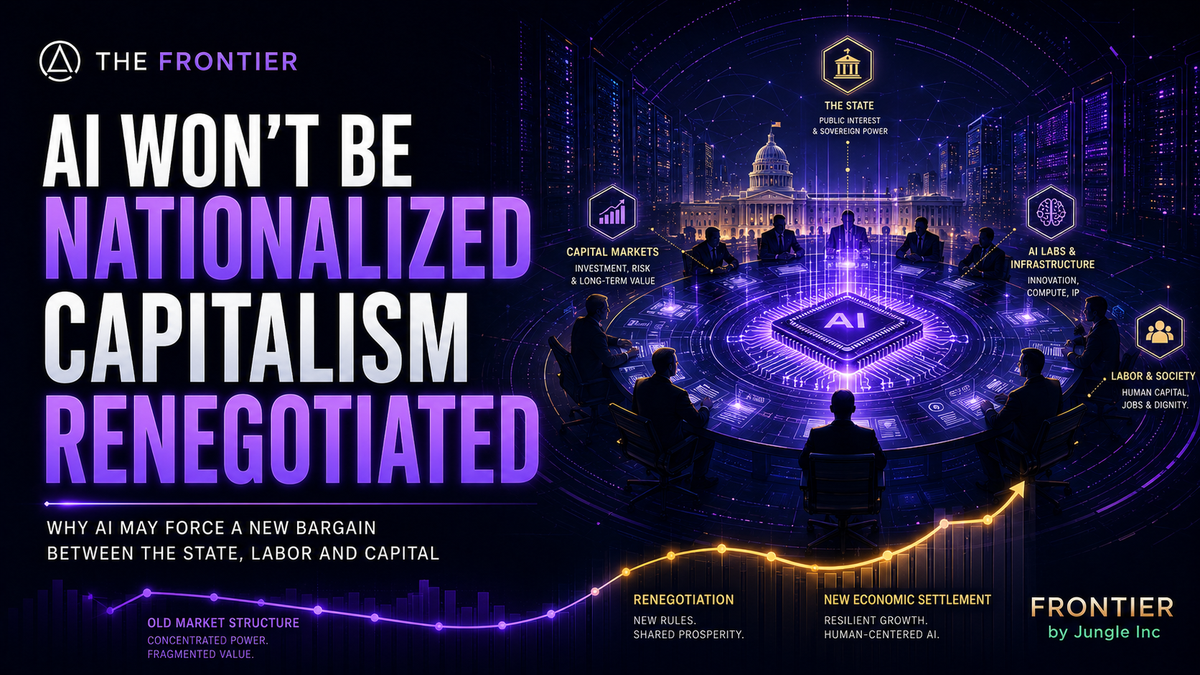
The debate over whether the United States will “nationalize” artificial intelligence is already using the wrong language. Nationalization belongs to an older economic era defined by railroads, oil fields, banks, utilities, and defense contractors. AI is different. It is not simply another strategic industry that government may regulate, subsidize, or partially own.
If frontier labs are directionally correct, artificial intelligence may become the first general-purpose technology capable of materially weakening the economic centrality of human cognitive labor. That possibility makes the public-ownership debate far more important than markets currently appreciate.
The Realistic Path: Strategic Bargaining, Not Seizure
The near-term question is not whether Washington will seize OpenAI, Anthropic, xAI, Google, or Meta. That is not the base case. The more realistic trajectory is a strategic bargaining regime in which the state demands model access, cybersecurity testing, defense integration, compute visibility, energy planning, infrastructure coordination, and eventually some form of public economic upside.
President Trump has said his administration will “look into” Americans receiving a stake in AI companies. Reporting has described early discussions around government stakes or public-equity mechanisms. Bernie Sanders has proposed a more aggressive 50% public ownership model. Sam Altman has expressed support for public equity concepts while opposing the scale of Sanders’ proposal.
These headlines are easy to dismiss as politics. That would be a mistake. The significance is not that a 50% public ownership proposal is likely to pass. The significance is that public participation in AI wealth has moved from the margins into the center of American political debate. When the most pro-capitalist recent Republican president, a leading democratic socialist senator, and the CEO of the most important AI company in the world are all discussing how the public should share in AI returns, the market should assume something structural is underway.

AI Is Moving From Software to Sovereign Infrastructure
For most of the post-ChatGPT era, markets treated AI as a private technology cycle. Labs raised capital. Hyperscalers built data centers. Nvidia supplied the compute layer. Venture capital funded applications. Public investors chased semiconductors, cloud, power, and AI software.
That phase is not over, but it is no longer sufficient. AI is becoming too economically and strategically important to remain ordinary private software.
The White House already operates a voluntary framework for leading developers to submit frontier models for federal cybersecurity testing before public release. This is not mandatory licensing or state control, but it places the federal government inside the release process for the most powerful systems. The direction of travel is clear: the state wants visibility before advanced AI enters the broader economy.
This is how strategic sectors evolve. Governments rarely begin with ownership. They begin by identifying dependencies. In AI those dependencies are everywhere: chips, power, cooling, data centers, classified cloud, cybersecurity, export controls, defense procurement, critical infrastructure, and national competition with China.
The state does not need to seize the labs to bargain with them. It already controls things the labs need — permits, energy coordination, export approvals, defense access, cybersecurity credibility, procurement pathways, political legitimacy, and public tolerance for massive data-center buildouts. The government can trade access to those bottlenecks for information rights, safety obligations, testing regimes, infrastructure commitments, and public upside.
That is the investable version of the story. It is not a seizure story. It is a dependency story.
Why Public Upside Becomes More Plausible
The public-upside debate will intensify over the next five to ten years because AI is likely to create a distribution problem before it creates a formal ownership problem. If productivity gains flow primarily to a small group of companies and shareholders while labor markets weaken, the political system will search for mechanisms to reconnect the public to the gains.
Those mechanisms could include non-voting warrants, revenue shares, compute royalties, public wealth funds, automation-linked fees, infrastructure equity, model licensing, citizen dividend pools, or public-benefit share classes.
The mechanism matters enormously. A negotiated warrant attached to federal support could become investable. A forced voting stake or punitive equity transfer would be valuation destruction. Investors should not treat all public participation as equivalent.
Sanders’ 50% proposal matters even if it never passes. It defines the left edge of the debate. Once confiscation is on the table, negotiated 1–5% public claims begin to look like reasonable compromise. Trump’s interest matters from the other direction: it shows public participation in AI wealth is not only a progressive idea. It can fit a populist message that if AI companies become extraordinarily profitable while ordinary Americans face disruption, the public deserves a share of the upside.

The Capitalism Problem
The deeper long-term question is not whether government owns part of AI. It is whether capitalism can remain politically stable if AI captures a growing share of economically valuable cognitive work.
Past automation displaced some tasks but created new industries, new jobs, and new demand. AI that can write code, analyze documents, generate media, handle customer service, conduct research, design products, and coordinate other systems begins to challenge the economic relevance of a much broader swath of the labor force.
If that capability continues compounding, the bottleneck shifts from labor to ownership. The winners become the entities that own the productive machines: model companies, chip suppliers, cloud platforms, power assets, data centers, distribution layers, and capital claims on the AI economy.
If labor income loses share and capital income gains share, capitalism does not end, but it becomes more politically fragile. A system built on the assumption that most people earn through wages cannot remain stable indefinitely if wages decouple from output.
Public participation is not merely a moral argument. It may become a macroeconomic stabilizer. The state may need a claim on AI productivity not to punish innovation, but to fund the society that innovation disrupts.
The China Comparison
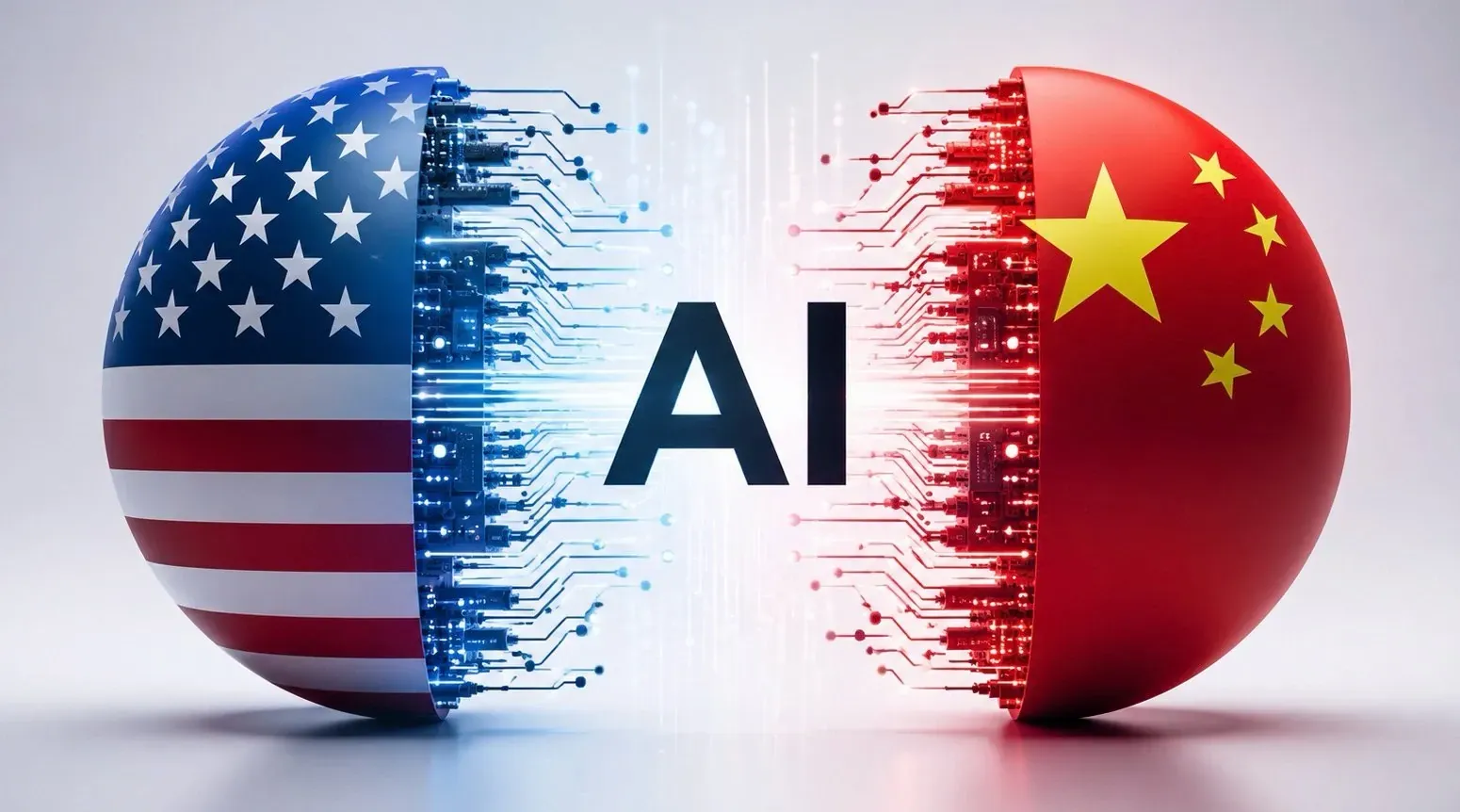
China has not simply nationalized AI. It has integrated AI into a state-directed model linking industrial policy, infrastructure, capital allocation, surveillance, and national-security priorities. This gives real advantages in coordination, speed, and long-term planning.
America’s advantage is different: deeper capital markets, stronger frontier labs, superior talent attraction, a more open research culture, greater entrepreneurial experimentation, and higher global trust in its platforms.
The risk is that the U.S. imports the control features of China’s model without gaining its command efficiency. The opportunity is a hybrid: enough state coordination to build infrastructure, secure the technology, and share some upside, without destroying the private incentives that created U.S. leadership.
Too little state involvement risks fragmented infrastructure, public backlash, and strategic vulnerability. Too much risks crushing innovation and turning frontier labs into politicized utilities. The optimal path is coordinated capitalism with public participation.
Investment Implications: Who Solves Sovereign Bottlenecks?
The investor question should no longer be “Who has AI exposure?” The better question is: Who solves a sovereign bottleneck?
As AI becomes strategic infrastructure, winners are likely to be companies that make state coordination possible without sacrificing private-sector speed.
1. Compute
Advanced GPUs, ASICs, networking, memory, high-performance interconnects, and trusted compute environments are no longer just technology inputs. They are geopolitical assets. Companies expanding secure, scalable, domestic, or allied compute capacity remain central to the national AI stack.

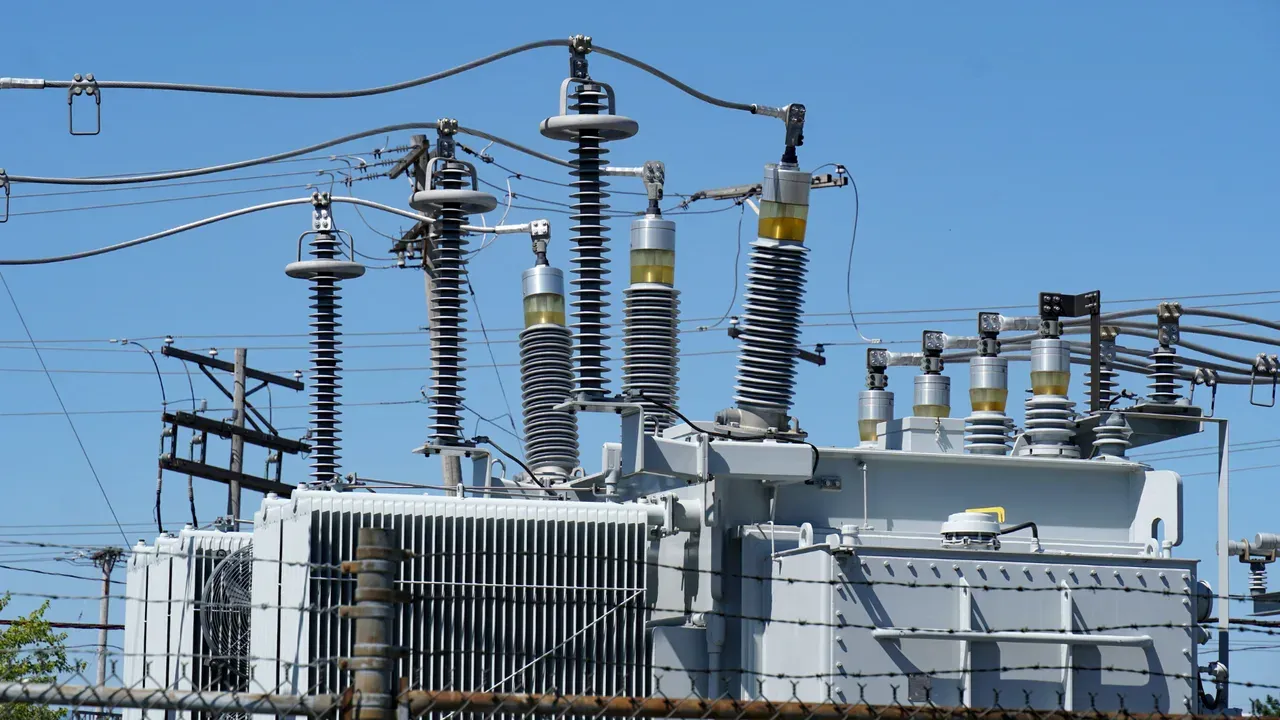
2. Power
Frontier AI requires data centers, cooling, transmission, generation, grid equipment, and long-duration energy planning. Gas, nuclear, storage, transformers, and data-center power development are becoming as important to AI deployment as software talent.
3. Secure Deployment
AI that cannot be deployed safely into defense, intelligence, finance, healthcare, and critical infrastructure will be less valuable. Classified cloud, zero-trust architecture, red-teaming, model evaluation, and secure inference environments grow in importance.
4. Accountability & Compliance
Model testing, audit infrastructure, incident reporting, verification tools, and monitoring platforms may become some of the most durable parts of the stack as the state relies more heavily on AI.
5. Supply-Chain Control
Semiconductor manufacturing, advanced packaging, trusted hardware, and export-control compliance are already national-security priorities. AI deepens this logic.
6. Financing & Public Distribution
AI buildout increasingly looks like infrastructure finance. This opens doors to public-private structures and negotiated public upside. If future mechanisms distribute productivity gains (dividends, funds, credits), the state will need modern financial rails — identity, payments, digital wallets, and sovereign administration systems.
The New Moat
The next AI moat may be institutional as much as technical. Companies that gain federal legitimacy, procurement access, secure deployment pathways, infrastructure support, and defense relevance could trade at a premium to firms that merely have good products.
Heavy compliance costs, early-access testing, cyber requirements, federal audits, and infrastructure partnerships favor large firms with capital, legal teams, and government relationships. Startups can still produce breakthroughs, but the path from breakthrough to scaled, trusted deployment may narrow.
The Timeline
- Next 1–3 years: Deeper strategic bargaining — more voluntary model access, cyber testing, frontier reporting, federal audits, defense integration, and public-private programs. No nationalization required.
- Next 3–7 years: Public upside becomes more plausible if AI-driven job anxiety rises. Non-voting warrants, revenue shares, compute fees, or public dividend pools could emerge as political compromises.
- Next 7–10 years: If AI captures a large share of economically valuable work, the capitalism question becomes harder to avoid. Deeper redesign — ownership pools, AI dividends, tax restructuring, or new mechanisms — may enter serious debate.
What the Market Is Missing
Markets have moved through stages: first the model layer, then chips, then data centers, then power. The next layer is political.
If AI becomes the dominant productivity engine, the state will not allow all gains to accrue privately while labor disruption, social insurance pressure, energy strain, and political instability accrue publicly. That imbalance will not hold.
This does not mean the U.S. will seize the AI labs. It means the public sector will negotiate for a claim on the AI economy. At first that claim may look small — a voluntary agreement, a warrant, a safety framework, a procurement rule, a compute partnership. Over time, those mechanisms could form a new economic architecture.
The companies that win will be the ones that turn state involvement into a moat without becoming state-controlled utilities. The companies that lose will be those excluded from the preferred federal AI stack.
AI nationalization is probably the wrong frame.
The better frame is renegotiation.
The state is becoming a silent co-founder of the AI economy because AI is moving beyond normal technology into the zone where productivity, labor income, tax capacity, military power, infrastructure, and political legitimacy converge.
The first stage is bargaining.
The second stage is public upside.
The third stage is capitalism redesigned around machine productivity.
That is why this story matters. The market is asking whether the government will own part of AI. It should be asking whether AI becomes so powerful that private ownership alone becomes politically, economically, and socially unstable.
Because if labor stops being the primary source of income, the state will look for income where the machines are.
Jungle Inc covers institutional finance, crypto infrastructure, and geopolitics. This is not financial advice. Conduct your own due diligence or consult your advisor. Market conditions and timelines can change rapidly.