
The $4 Trillion Question: SpaceX, OpenAI, and Anthropic
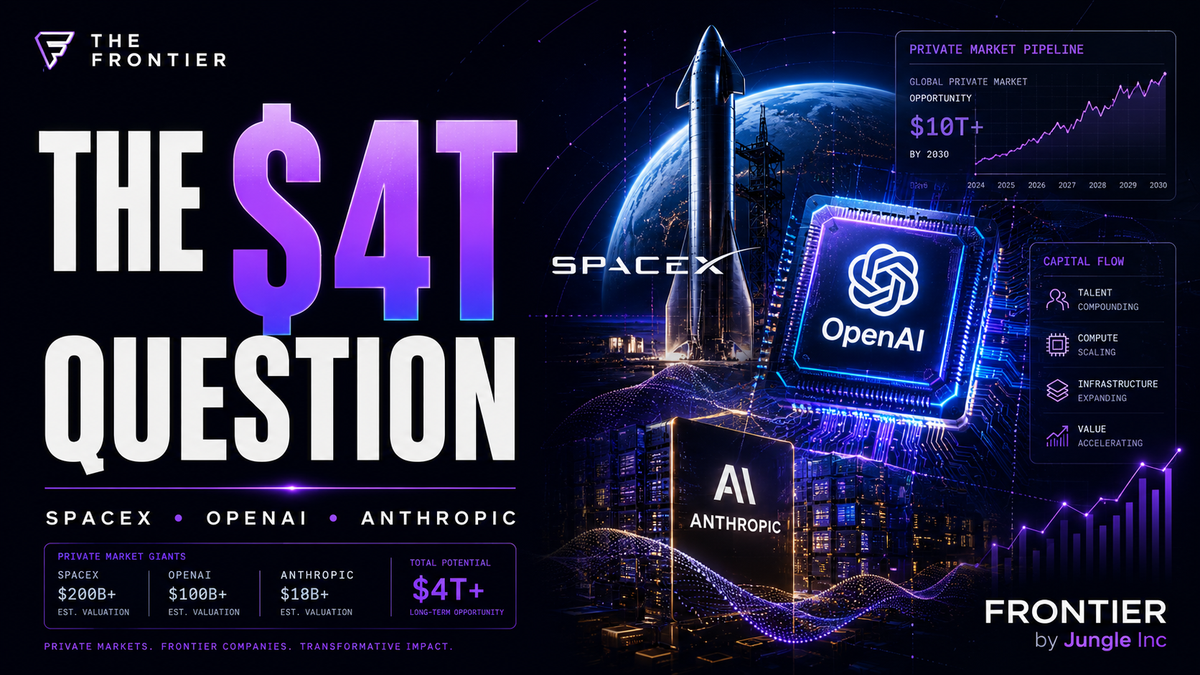
The potential public listings of SpaceX, OpenAI, and Anthropic could represent one of the largest single waves of growth equity to enter public markets in a single cycle. If all three companies complete their transitions, with SpaceX already filed and the others in advanced preparation, the combined market capitalization entering public trading could exceed $3–4 trillion within 12–18 months.
These are not interchangeable “AI plays.” Each operates at a different stage of disclosure, with unique business models, governance structures, revenue trajectories, and risk profiles. Below is a detailed, data-driven breakdown drawn directly from SEC filing summaries, official company disclosures, and credible reporting.
SpaceX: The Only Live Deal: With the Highest Valuation Bar

SpaceX filed its S-1 with the SEC on May 20, 2026. The company is targeting Nasdaq under ticker SPCX, with a reported roadshow beginning June 4, pricing on June 11, and first trade on June 12. The targeted raise is approximately $75 billion at a $1.75 trillion valuation, which would make it the largest U.S. IPO on record.
Key financials from the filing summaries
- 2025 revenue: $18.67 billion
- Starlink contribution: $11.39 billion in 2025 and $3.26 billion in Q1 2026
- Paid Starlink subscriptions: 10.3 million by March 31, 2026
- 2025 net loss: nearly $4.9 billion
- Q1 2026 operating loss: $1.94 billion
- AI/X segment: $818 million revenue against roughly $2.47 billion in losses in Q1 2026
The core investment thesis still centers on Starlink transforming SpaceX from a capital-intensive launch provider into a recurring-revenue connectivity business with embedded defense and government optionality. Recent contracts include a $1.15 billion NASA lunar lander modification, a $1.8 billion NRO spy-satellite deal, and fresh Space Force awards totaling more than $6.45 billion.
But the IPO story is no longer just rockets and Starlink. The S-1 appears to position SpaceX as a broader infrastructure platform: launch, satellite broadband, defense systems, AI compute, and potentially developer software distribution.
Anthropic Compute Deal: Big Revenue Potential, But Not Cleanly Long-Term
One of the most important new wrinkles is SpaceX’s compute agreement with Anthropic. Reuters reports that SpaceX agreed to lease Anthropic access to its Colossus and Colossus II AI data-center clusters, with headline economics of roughly $1.25 billion per month through May 2029. However, the same reporting notes that the arrangement includes mutual termination rights with 90 days’ notice, and Elon Musk later clarified that SpaceX had only committed to a 180-day lease, not a firm multi-year obligation.
That distinction matters. On paper, the deal could look like a massive recurring-revenue stream that helps validate SpaceX’s AI infrastructure buildout. In practice, investors should treat it as a high-value but flexible compute lease, not a guaranteed multi-year contracted backlog. The agreement is bullish because it shows real third-party demand for SpaceX’s AI infrastructure, but it also creates disclosure risk if the market capitalizes the full potential deal value without accounting for the short-duration cancellation rights.
The issue is especially important because SpaceX’s AI/X segment is currently deeply loss-making. Reuters reported that the AI segment generated $818 million of revenue in Q1 2026 but posted roughly $2.5 billion of operating losses. That makes the Anthropic deal strategically important, but not yet proof that SpaceX has built a profitable AI cloud business.
Cursor / Anysphere Option: The Developer-Tool Angle
The second major AI-related development is SpaceX’s reported option around Cursor, the AI coding platform developed by Anysphere. Reuters reports that SpaceX said it has the option to acquire Cursor later in 2026 for $60 billion, or alternatively pay $10 billion for a strategic partnership.
The strategic logic is clear: if SpaceX is building AI infrastructure through Colossus and competing through xAI/Grok, Cursor gives it a front-end distribution layer in one of the most valuable AI markets: coding assistants and developer workflows.
That matters because AI coding is one of the clearest enterprise monetization wedges in the current AI market. Anthropic’s Claude Code, OpenAI’s coding tools, GitHub Copilot, and Cursor are all competing for developer mindshare. If SpaceX ultimately acquires or deeply partners with Cursor, it would give SpaceX a stronger software distribution channel to pair with its compute infrastructure. In other words, SpaceX would not just be renting GPUs. It would be trying to own more of the AI stack: compute, model development, user interface, and enterprise developer workflow.
Updated Key Risks to Weigh
Valuation risk: At roughly 94x 2025 trailing revenue, SpaceX is being valued less like a conventional aerospace or telecom business and more like a scarcity mega-platform with multiple future option pools. That valuation assumes major success across Starlink, Starship, defense, and now AI infrastructure.
Governance risk: Elon Musk reportedly retains approximately 42.5% equity but 83.8% voting control through super-voting shares. This gives public investors limited governance leverage despite the scale of the offering.
AI disclosure risk: The Anthropic compute deal is valuable, but the market needs to understand the actual contract duration, cancellation rights, renewal terms, and margin profile. The public contradiction between the S-1 narrative and Musk’s later clarification creates a real disclosure-quality issue.
AI capital intensity: SpaceX’s AI/X segment currently looks expensive and loss-making. If AI compute becomes a major part of the IPO narrative, investors need to see whether this segment can eventually produce attractive margins or whether it remains a high-capex cash drain.
Cursor execution risk: A potential $60 billion Cursor acquisition would give SpaceX a stronger developer-tool story, but it would also increase integration risk and raise questions about whether SpaceX is becoming too sprawling ahead of its public debut.
Starship / FAA execution risk: Ongoing FAA review following the May 22 Starship flight remains central because Starship is still a major part of the long-term valuation case.
Investor Perspective
SpaceX offers the most immediate trading setup of the three expected mega-IPOs because of scarcity, broad retail interest, passive/index inclusion mechanics, and a staged lock-up structure designed to ease early supply pressure. But the investment case is becoming more complicated.
The original thesis was easier to underwrite: Starlink recurring revenue plus launch dominance plus defense optionality. The updated thesis is broader and more ambitious: SpaceX as a vertically integrated space, broadband, defense, AI compute, and AI software infrastructure company.
That broader story could justify a premium valuation if SpaceX proves it can turn Starlink scale and AI infrastructure into durable, high-margin cash flow. But at the targeted valuation, investors are being asked to pay upfront for several layers of future optionality that remain unproven.
The cleanest framing is this:
SpaceX is no longer just the Starlink IPO. It is being positioned as Elon Musk’s master infrastructure company: rockets, satellites, broadband, defense, AI compute, and potentially AI coding distribution through Cursor. That makes the upside larger, but it also makes the risk profile much harder to model.
OpenAI: Strongest Commercial Momentum: With the Most Complex Economics
OpenAI: The Broadest AI Platform, but Also the Most Complex IPO Story
OpenAI has not yet filed publicly, but reporting indicates a target IPO window as early as September 2026, with Goldman Sachs and Morgan Stanley involved in draft prospectus work and potential additions of Citigroup and JPMorgan. Recent reporting also indicates that large U.S. funds are already preparing for mega-cap AI IPO supply, including OpenAI, because potential rapid index inclusion could create significant institutional demand.
OpenAI’s core investment case is straightforward: it has the strongest multi-channel AI business model of the group. It is not dependent on one product, one customer type, or one monetization path. The company has consumer subscriptions, enterprise seats, API usage, coding tools, agentic products, and platform distribution through ChatGPT. That gives OpenAI a broader revenue surface than a pure enterprise AI provider or an infrastructure-only AI company.
Commercial scale stands out
OpenAI’s current commercial footprint is unmatched among private AI companies.
- Official 2025 revenue: $20 billion+ ARR
- Reported actual 2025 revenue: approximately $13 billion
- Run-rate as of March 2026: roughly $2 billion per month, or about $24 billion annualized
- Weekly active users: approximately 900 million
- Consumer subscribers: approximately 50 million
- Paying business users: more than 9 million
- Enterprise mix: already over 40% of revenue and expected to approach parity with consumer by year-end
This multi-channel model is rare. ChatGPT provides consumer distribution at global scale. The API gives developers and startups direct access to OpenAI models. Enterprise offerings create higher-value recurring revenue. Codex and agentic tools give OpenAI exposure to developer productivity and business automation. The result is a platform with both top-of-funnel consumer reach and high-value enterprise conversion.
The strongest bullish interpretation is that OpenAI is becoming the default AI operating layer for consumers, developers, and enterprises. The cautious interpretation is that user scale does not automatically translate into durable profit if inference costs remain high and competitors pressure pricing.
Product surface: more than ChatGPT
For investors, OpenAI should not be analyzed as just “the ChatGPT company.” ChatGPT is the distribution engine, but the monetization stack is broader.
The key product pillars are:
- Consumer ChatGPT: paid subscriptions, high brand recognition, and massive daily engagement
- Enterprise ChatGPT: business seats, team deployment, administrative controls, and compliance-oriented usage
- API/platform revenue: developer usage and third-party application integration
- Codex and coding agents: developer productivity, software automation, and enterprise engineering workflows
- Agentic products: task completion, research, automation, and workflow execution
- Potential hardware/interface layer: longer-term optionality tied to the Jony Ive/io acquisition and future AI-native devices
The reason this matters is that OpenAI has multiple ways to expand wallet share. A consumer user can become a paid subscriber. A developer can become an API customer. A business can start with ChatGPT seats and later adopt Codex, agents, API usage, or custom workflow tools. That cross-sell potential is a major part of the valuation case.
Microsoft relationship: strategic asset and key dependency
Microsoft remains one of the most important diligence items. It reportedly holds roughly 27% equity, serves as OpenAI’s primary cloud partner, and maintains an IP license through 2032. Payments to Microsoft reportedly continue through 2030, with The Information reporting a total revenue-sharing cap of $38 billion, later summarized by Reuters.
This relationship is both a strength and a constraint.
It is a strength because Microsoft gives OpenAI distribution, enterprise credibility, Azure scale, and embedded access to the Microsoft ecosystem. It also helped fund OpenAI through the most capital-intensive phase of frontier model development.
It is a constraint because IPO investors will need to understand how much economics flow to Microsoft, how much cloud dependency remains, what rights Microsoft retains to OpenAI IP, and whether OpenAI can diversify compute without damaging the relationship. The reported $38 billion cap would be positive if confirmed because it limits long-term revenue-sharing leakage and could improve public-market readability. But investors should wait for the prospectus to confirm the actual structure.
Compute and margin pressure
Compute is the biggest financial question in the OpenAI IPO.
Reuters reported that OpenAI expects approximately $600 billion of compute spending through 2030, including roughly $50 billion in 2026. The same reporting said OpenAI generated approximately $13 billion of actual 2025 revenue, kept expenses below projected levels at roughly $8 billion, and expects revenue to exceed $280 billion by 2030.
The problem is margin compression. Reuters reported that inference costs quadrupled in 2025, causing adjusted gross margin to decline from 40% in 2024 to 33% in 2025.
That is the central OpenAI debate. The company may have the best demand profile in AI, but the cost of serving that demand is enormous. If inference efficiency improves, OpenAI could become one of the most valuable software platforms in history. If compute costs rise in line with usage, the business may look less like high-margin SaaS and more like a capital-intensive AI utility.
Governance and legal structure
OpenAI’s structure is another major IPO diligence item. The for-profit entity remains controlled by the OpenAI Foundation, creating a governance model that differs from a normal public company. For public investors, the key question is how shareholder economics will be balanced against the Foundation’s mission control.
The prospectus will need to address:
- Foundation control over the for-profit operating entity
- Board appointment and removal rights
- Related-party transactions
- Microsoft rights and economics
- Historical restructuring issues
- Litigation involving Elon Musk and other governance disputes
- Copyright and training-data litigation
- How future AGI or safety-related obligations affect shareholder rights
The governance story may be acceptable to public investors if it is clearly disclosed and stable. But it will likely trade with a governance discount unless the prospectus gives investors confidence that the economic rights are clean, durable, and enforceable.
Valuation framework
OpenAI was most recently reported around an $852 billion valuation. On a $20 billion+ ARR base, that implies roughly 42x ARR. On the March 2026 run-rate of approximately $24 billion annualized, the multiple is closer to 35x run-rate revenue. On reported actual 2025 revenue of approximately $13 billion, the multiple is much higher at roughly 65x revenue.
That valuation can be justified only if investors believe OpenAI’s revenue base can scale rapidly while margins improve. The bull case is that OpenAI becomes the dominant AI application and platform layer across consumer, enterprise, developer tools, and agents. The bear case is that frontier AI competition turns into a compute-heavy margin war where model access becomes increasingly commoditized.
Critical line items for prospectus diligence
The prospectus needs to answer several questions before investors can properly underwrite the IPO:
- Microsoft economics: What percentage of revenue flows to Microsoft, what is the true cap, and what rights survive after IPO?
- Gross margin by product line: Are consumer subscriptions, enterprise seats, API usage, and Codex/agent products economically different?
- Inference cost trajectory: Are margins improving because models are becoming more efficient, or worsening as usage scales?
- Compute financing: How much of the $600 billion compute plan is committed, financed, or still aspirational?
- Customer concentration: How much revenue comes from large enterprise accounts versus broad-based usage?
- Enterprise retention and expansion: Are business customers expanding seats and usage after initial deployment?
- Legal exposure: How large could copyright, data, safety, and governance-related liabilities become?
- Control structure: What rights will public shareholders actually have under Foundation control?
Investor perspective
OpenAI currently presents the strongest underlying business quality among the three because it has the broadest monetization engine: consumer subscriptions, enterprise SaaS, API usage, developer tools, and agentic workflows. It also has the largest brand, the largest consumer distribution funnel, and one of the clearest paths to becoming an AI platform rather than a single-product company.
The decisive factor will be transparency. If the prospectus shows improving unit economics, a manageable Microsoft revenue-share structure, diversified compute supply, and strong enterprise retention, OpenAI could justify a premium valuation. If the filing shows worsening gross margins, unclear Microsoft economics, heavy capital commitments, or weak shareholder rights, the IPO could be far more fragile despite the company’s commercial strength.
Bottom line: OpenAI may be the highest-quality operating business among the expected AI IPOs, but it is also the most important one to diligence carefully. The demand side is proven. The unresolved question is whether that demand converts into durable, shareholder-aligned profitability after Microsoft economics, compute costs, governance constraints, and legal exposure are fully disclosed.
Anthropic: The Fastest Scaling Enterprise AI IPO Candidate

Anthropic has not filed an S-1 and has publicly stated it has not yet decided on final IPO timing or commitment. However, the company is clearly preparing for public-market optionality. It has reportedly hired Wilson Sonsini, engaged in bank discussions, and closed a $65 billion Series H at a $965 billion post-money valuation on May 28, 2026. Reuters reported that the round was led by Altimeter Capital, Dragoneer, Greenoaks, and Sequoia, with Coatue and ICONIQas co-leads. Strategic infrastructure partners including Micron, Samsung, and SK Hynix also joined the round.
The scale of the valuation is notable because Anthropic was valued at $380 billion in February 2026, meaning its valuation more than doubled in roughly three months. Reuters also reported that the latest valuation places Anthropic ahead of OpenAI’s last reported $852 billion post-money valuation from March 2026.
Revenue trajectory is exceptional
Anthropic’s commercial growth is the strongest part of the investment case.
- February 2026 official run-rate: $14 billion
- Early April 2026: surpassed $30 billion
- Early May 2026: crossed $47 billion in run-rate revenue
- Enterprise customers spending more than $1 million annualized: increased from 500+ to 1,000+ in roughly two months
- Claude Code: reached a $2.5 billion run-rate in February, with enterprise accounting for more than half of that revenue
Reuters directly cited Anthropic saying its run-rate revenue crossed $47 billion earlier in May, while AP reported that Claude demand is being driven by people and organizations using the product for coding, work, and personal tasks.
This makes Anthropic arguably the strongest pure-play enterprise AI growth story among the expected mega-IPO candidates. OpenAI still has the broader consumer brand, but Anthropic’s growth appears more directly tied to professional and enterprise workflows where customers can justify spending through productivity gains.
Product strength: Claude Code and professional workflows
Claude Code is the most important product inside the Anthropic story. It is not just a feature extension of Claude. It is one of the clearest signs that Anthropic can turn frontier-model performance into high-value enterprise revenue.
Coding assistants monetize well because the return on investment is measurable. If a company can reduce engineering time, accelerate debugging, automate test creation, migrate legacy systems, or improve developer productivity, the product can become deeply embedded in daily workflows. That makes Claude Code more strategically valuable than ordinary chatbot usage.
AP also noted that Anthropic launched Claude Opus 4.8 alongside the funding news and positioned it as stronger for coding and professional work than prior models.
The risk is concentration. If too much of Anthropic’s revenue acceleration is coming from coding and agentic developer tools, then the company is exposed to one of the most competitive areas in AI. OpenAI, Google, Microsoft/GitHub, Cursor, and xAI are all fighting for the same developer workflow layer.
Structural advantages and dependencies
Anthropic is structured as a Public Benefit Corporation with a Long-Term Benefit Trust designed to preserve mission alignment and responsible AI development over time. That structure may appeal to institutions looking for a cleaner AI governance story than a standard venture-backed startup, though it also introduces questions about how public shareholders will rank relative to mission-aligned governance constraints.
The company’s infrastructure strategy is both a strength and a dependency. Anthropic has major compute relationships across multiple providers rather than relying on one vendor. Its infrastructure partners include Amazon, Google/Broadcom, and reported access to SpaceX Colossus GPU capacity.
Amazon is especially important. Reuters reported that Amazon contributed $5 billion of previously committed capital into the latest round and may invest up to $25 billion in total. Reuters also reported that Anthropic has committed to spending more than $100 billion over the next 10 years on Amazon cloud technologies, in addition to Amazon’s prior $8 billion investment.
Separately, Reuters reported that Apollo and Blackstone are working on approximately $36 billion of debt financing tied to Anthropic’s AI infrastructure expansion. That debt would reportedly be used to purchase custom Google TPUs, which Anthropic would then lease, with Broadcom backstopping payments on the largest portions of the transaction.
The implication is clear: Anthropic’s growth is not classic software growth. It is software demand attached to hyperscale compute financing. That can support extraordinary revenue expansion, but it also makes the model capital-intensive and dependent on continued access to chips, power, cloud capacity, debt markets, and strategic partners.
Capacity constraints validate demand, but expose scaling risk
Reuters reported that Anthropic has struggled to meet demand in recent months, forcing the company to institute usage limits during peak hours and incentivize off-peak usage by offering more compute during those periods.
That is bullish and bearish at the same time. It validates that demand is real and supply-constrained. But it also shows that Anthropic’s revenue growth may be capped by infrastructure availability rather than customer interest. For IPO investors, the key question is whether new capital and debt financing can convert unmet demand into profitable revenue, or whether each new revenue layer requires another major wave of compute investment.
Profitability signal
Reporting indicates Anthropic may produce its first adjusted operating profit of approximately $559 million in Q2 2026, excluding stock-based compensation. If confirmed in future IPO filings, this would be a major de-risking event.
However, adjusted operating profit is not the same as free cash flow. Investors will still need to see gross margin, inference cost trends, stock-based compensation, cloud obligations, debt-service requirements, customer concentration, and whether enterprise customers are expanding usage at sustainable economics.
Valuation
At a $965 billion post-money valuation, Anthropic is expensive in absolute terms. But on the latest reported run-rate, the multiple is more defensible than it first appears.
Using the early May run-rate of $47 billion+, Anthropic is valued at roughly 20x run-rate revenue. Using the February official run-rate of $14 billion, the valuation would be nearly 69x run-rate revenue. That spread shows why the durability of the latest revenue figure is central to the IPO case.
Investor perspective
Anthropic demonstrates the most rapid commercial scaling of the group and may offer the cleanest enterprise AI narrative. Its advantages are clear: fast revenue growth, strong coding traction, expanding enterprise adoption, a differentiated governance structure, and backing from strategic infrastructure partners.
The central risk is that Anthropic’s growth may be compute-constrained, capital-intensive, and potentially concentrated in coding and agentic workflows. The IPO case becomes compelling if Anthropic can prove that its revenue is broadening across enterprise use cases while margins improve. It becomes much more fragile if growth depends on continuous capital raises, expensive compute leases, and aggressive infrastructure debt.
Bottom line: Anthropic may be the strongest pure-play AI growth asset heading toward the public markets, but investors should underwrite it less like a traditional SaaS company and more like a frontier AI infrastructure platform with software-level demand and hyperscale compute-level capital requirements.
What Investors Are Monitoring
Mutual funds and passive managers have been building cash positions in anticipation of these listings. New Nasdaq and FTSE fast-entry rules could accelerate benchmark inclusion, particularly for SpaceX, creating mechanical demand. Market psychology will also play a role: a strong SpaceX debut could broaden risk appetite for the subsequent offerings, while any softness would likely intensify focus on margins, governance, and disclosure quality.
The Bottom Line
On pure business quality, OpenAI currently ranks first thanks to its broad monetization engine and platform characteristics. On governance-adjusted structure, Anthropic stands out with its coherent mission-protective framework. On near-term trading dynamics, SpaceX benefits from being the only confirmed live deal with built-in scarcity and index mechanics.
Across all three, valuations embed substantial optionality rather than proven fundamentals. Compute costs, cloud dependencies, licensing obligations, and regulatory factors could still materially influence long-term earnings power. Full prospectuses will be essential for underwriting standardized economics.
These remain high-conviction growth opportunities that reward careful timing and selectivity. Pursue SpaceX participation primarily for its trading characteristics rather than assuming an immediate long-term fundamentals anchor. For OpenAI and Anthropic, prioritize waiting for public filings and clear disclosure on key economics before committing capital near current private marks.
Jungle Inc covers institutional finance, crypto infrastructure, and geopolitics. This is not financial advice. Conduct your own due diligence or consult your advisor. Market conditions and timelines can change rapidly.